Built a 6-person product org from zero, with company-wide OKRs. The insurance pivot, 24/7 MDR as actual risk managed, became a key differentiator in the €17M Series A of November 2022. Three years later, all of it is still in use.
Product leadership for SaaS & e-commerce scale-ups
Every team is shipping. The product organisation still feels stuck.
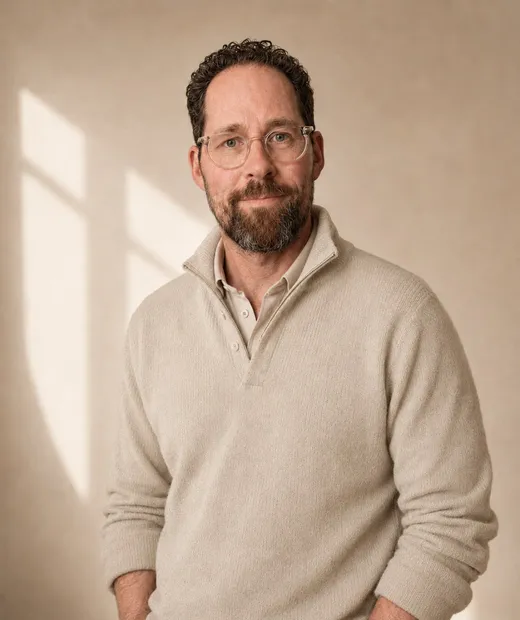
In most scaling SaaS and e-commerce companies the wall isn't one broken part, it's the connections between them. I'm Rein Groot. I find the systemic pattern others miss and turn it into a product organisation that runs, from pre-seed to 500+ people.
20+ yearsin digital product strategy and creation
30+ organisationsfinancial services, retail, telecom, mobility
2 to 500+ peoplepre-seed to corporate
Sound familiar?
The parts are staffed. The system is stuck.
01You've hired specialists for every function, and it still feels stuck.
02Every team optimises its own metric. Nobody owns the whole.
03The roadmap is a wish list, not a strategy.
04Leadership asks for data literacy the org doesn't have yet.
05You suspect the real problem is bigger than any single hire.
These are not five problems. They are one system, seen in pieces.
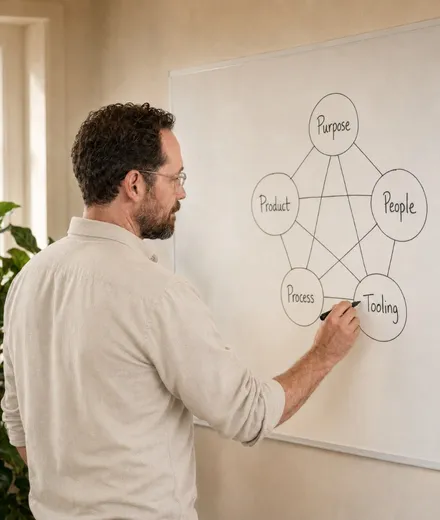
The RRR-framework
One scan, five dimensions, and the connections between them.
I run one scan across five dimensions, and I read the connections between them. That is where the real leverage lives, and where most leaders never look.
When the five align
RustCalm. The org stops firefighting.
RegelmaatCadence. Shipping becomes predictable.
ReinheidClarity. Everyone can say what matters and why.
Cases, with outcomes.
Real work. Real outcomes.
Six months as interim Head of Product at an AI tender-management scale-up that had outgrown founder-led product. Delivery back to one epic at a time, prioritisation tied to ARR and churn, and the release leadership called existential, shipped. Handed over to a permanent successor with the org steady and ready to scale.
Five organisational dysfunctions were running at once, each feeding the others. Mapped the whole system, fixed it in the order the map dictated, and left a department with a strategy it owns and a team that carries it.
Any stage. Same scan.
Most leaders have one playbook. I have the full range, because I've lived every role in both product and services contexts.
Pre-seed
The first product hire who actually gets the chaos.
From 2 founders and an idea to something you can demo and fund, then hiring and forming the first product team around it.
Scale-up · the sweet spot
Product orgs built from zero that scale.
Series A to B, 15 to 100 people, when the wish list needs to become a strategy.
Corporate
Patterns others miss, fixed systematically.
Multiple dysfunctions at once, mapped and untangled at 500+ person scale.
For investors
An operator you can drop into a portfolio company.
Diagnose a struggling product org before a follow-on round, or step in as interim product leadership to fix it. You get an honest read, fast, from someone who has run the role at every stage.
Where the range comes from
I was the entire product org before I led one.
Early at Ad4all and Lazzo, one SaaS and one e-commerce, I was developer, UX designer, Scrum Master and business consultant at once, in both product and services contexts. What I did unconsciously for years, I now run as an explicit scan.
20+ years and 30+ organisations later, across financial services, retail, telecom and mobility, the pattern reading is the job: seeing the whole system where others see only their part, and making it run.
Start with a conversation.
30 minutes. I'll tell you what I see. No pitch.